Every liver transplant journey is unique. While many patients undergo routine transplant evaluation, some cases present extraordinary challenges that require meticulous planning, multidisciplinary collaboration, and unwavering trust between the patient, family, and healthcare team.
This is the story of a patient from Yemen whose journey to recovery involved not only advanced surgical expertise but also remarkable determination, family support, and the collective efforts of a dedicated transplant team. It reflects how modern liver transplantation can offer hope even in highly complex clinical situations.
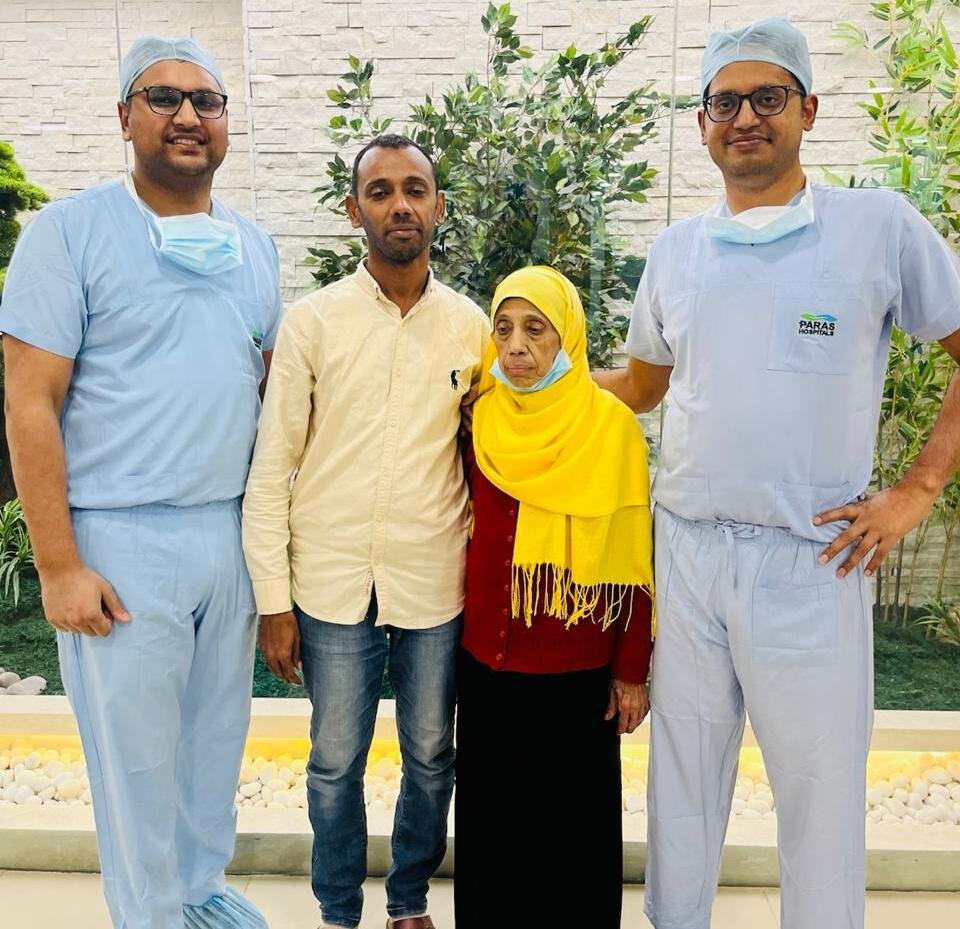
Patient Background
A 62-year-old woman from Yemen sought medical attention after experiencing persistent weight loss and generalized weakness. Further evaluation in her home country revealed chronic liver disease caused by Hepatitis C infection along with hepatocellular carcinoma (HCC), the most common form of primary liver cancer.
Given the limited availability of advanced liver transplant services locally, her family explored treatment options abroad. They were introduced to our transplant program through the recommendation of a previous patient who had successfully undergone liver transplantation in India.
After arriving at Paras Health, Gurugram, she underwent a comprehensive transplant evaluation involving hepatologists, transplant surgeons, radiologists, anesthesiologists, and other specialists.
Evaluation and an Unexpected Challenge
Following detailed investigations, liver transplantation was recommended as the most appropriate treatment option.
Her daughter voluntarily came forward to become a living liver donor. However, after undergoing a comprehensive donor evaluation, she was unfortunately found to be medically unsuitable for donation. This was an emotionally difficult moment for the entire family.
Meanwhile, the patient’s health continued to decline. She became increasingly frail, experienced repeated hospital visits, and her body weight dropped significantly, making timely treatment even more critical.
Considering an ABO-Incompatible Liver Transplant
After careful multidisciplinary discussions, an ABO-incompatible living donor liver transplant was considered.
In most liver transplant procedures, the donor and recipient have compatible blood groups. However, in selected patients, transplantation between different blood groups can be performed using carefully planned protocols, specialized medications, and close monitoring.
Such procedures require detailed preparation before surgery, including immune modulation strategies, plasma exchange when appropriate, meticulous perioperative planning, and intensive post-operative monitoring.
The decision was made only after carefully balancing the potential benefits and risks and after extensive discussions with the patient and her family.
A Successful Liver Transplant and Recovery
The transplant procedure was successfully performed.
Following surgery, the patient recovered steadily and was discharged from the hospital on the twelfth postoperative day. Approximately four weeks after transplantation, she was able to return home to Yemen.
She continues regular follow-up and has recovered well, demonstrating how timely intervention and coordinated multidisciplinary care can transform outcomes even in highly complex transplant cases.
A Reflection on Belief and Faith
Every liver transplant represents far more than a surgical procedure.
It is a journey built upon science, careful planning, teamwork, compassion, and trust. Patients and their families often face uncertainty, difficult decisions, and emotional challenges throughout the transplant process.
This experience reinforced my belief that while clinical expertise guides every medical decision, hope, resilience, and mutual trust between patients and the healthcare team remain equally important. Successful outcomes are made possible through the collective dedication of transplant surgeons, hepatologists, anesthesiologists, intensivists, nursing staff, transplant coordinators, and, above all, the courage shown by patients and their families.
Frequently Asked Questions
Can a liver transplant be performed between different blood groups?
Yes. In carefully selected patients, an ABO-incompatible liver transplant may be performed using specialized protocols and close monitoring by an experienced transplant team.
Is an ABO-incompatible liver transplant safe?
These procedures are more complex than standard liver transplantation but can achieve good outcomes when performed in experienced transplant centres with appropriate patient selection and multidisciplinary care.
Why do patients travel to India for liver transplantation?
India has several high-volume transplant centres with experienced multidisciplinary teams, advanced surgical expertise, and comprehensive post-operative care, making it a preferred destination for many international patients.
How long does recovery take after liver transplantation?
Recovery varies from patient to patient. Most individuals spend around two to three weeks in the hospital, followed by several weeks of recovery and regular follow-up before resuming normal daily activities, depending on their overall health and clinical progress.
While every patient’s medical condition is unique, this case demonstrates how careful evaluation, advanced surgical planning, and multidisciplinary transplant care can make complex liver transplantation possible in appropriately selected patients.
Conclusion
Every successful liver transplant is a reminder that even the most complex medical situations can often be addressed through timely diagnosis, careful planning, advanced surgical expertise, and multidisciplinary collaboration. Stories such as this continue to inspire our commitment to providing compassionate, evidence-based liver transplant care for patients from India and around the world.